
Bhushan Ekbote · June 20, 2026
Feedback and Coaching
I was on a call last week with an owner who told me his team "just doesn't perform the way he needs them to."
I asked him when he last sat down with someone on his team to give them direct, honest feedback about where they stood.
He paused. Then said, "I mean, they know when something's wrong. I make it pretty obvious."
That's not feedback. That's mood management.
The gap between what most owners expect and what their teams actually understand is enormous. And the bridge between those two things is consistent, clear coaching. Not annual reviews. Not vague frustration. Real conversations where someone walks away knowing exactly what good looks like and where they need to grow.
Here's what I've seen in companies that actually scale. The owners who step back successfully are almost always the ones who built a culture where feedback flows constantly, not just downward, but in every direction. Their managers coach. Their teams self-correct. Problems surface early instead of exploding late.
That doesn't happen by accident. It happens because the owner decided that developing people was a core part of the job, not a distraction from it.
If your business still depends on you to catch every problem and correct every mistake, the issue probably isn't your team's performance.
It's that no one has ever been properly coached on what great actually looks like.
So here's the question. When did you last give someone on your team feedback that was specific enough to actually change their behavior?
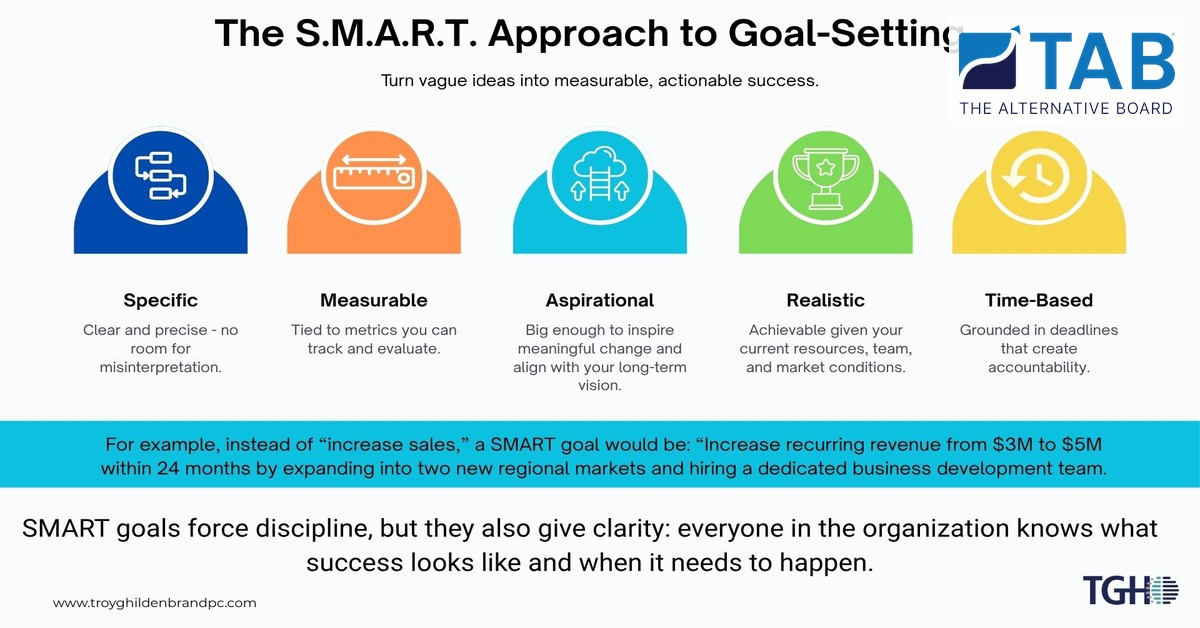
The S.M.A.R.T. Approach to Goal-Setting
Turn vague ideas into measurable, actionable success.
- Specific: Clear and precise - no room for misinterpretation.
- Measurable: Tied to metrics you can track and evaluate.
- Aspirational: Big enough to inspire meaningful change and align with your long-term vision.
- Realistic: Achievable given your current resources, team, and market conditions.
- Time-Based: Grounded in deadlines that create accountability.
For example, instead of "increase sales," a SMART goal would be: "Increase recurring revenue from $3M to $5M within 24 months by expanding into two new regional markets and hiring a dedicated business development team.
SMART goals force discipline, but they also give clarity: everyone in the organization knows what success looks like and when it needs to happen.
www.troyghildenbrandpc.com
From "The Owner's Almanac" - 90 days to build a business that runs without you. Available on Amazon.