
Bhushan Ekbote · June 1, 2026
Firing Fast
I had a call last week with an owner who knew, for over a year, that someone on his team wasn't working out.
He kept hoping it would get better. He gave more feedback, more chances, more patience. Meanwhile, his best people were quietly frustrated watching it play out. His own energy was going toward managing around the problem instead of building toward the opportunity.
When he finally made the move, his exact words were: "I should have done that ten months ago."
I hear this constantly. The slow fire is one of the most expensive decisions a business owner makes, and it rarely feels like a decision at all. It feels like compassion, or fairness, or giving someone the benefit of the doubt. But what it usually is, if you're honest, is avoidance.
The person staying too long often knows it too. They're not thriving. They're stuck in a role that isn't right for them, on a team that has quietly moved on without them.
Firing fast isn't about being ruthless. It's about being honest, with yourself and with them, before the cost compounds. The longer you wait, the more it costs. In morale, in momentum, in your own mental bandwidth.
The best operators I've worked with have learned to trust the signal earlier. Not to be reactive, but to stop pretending they don't see what they already see.
So here's the question worth sitting with: Is there someone on your team right now that you already know isn't the right fit, but you're still waiting on?
What are you actually waiting for?
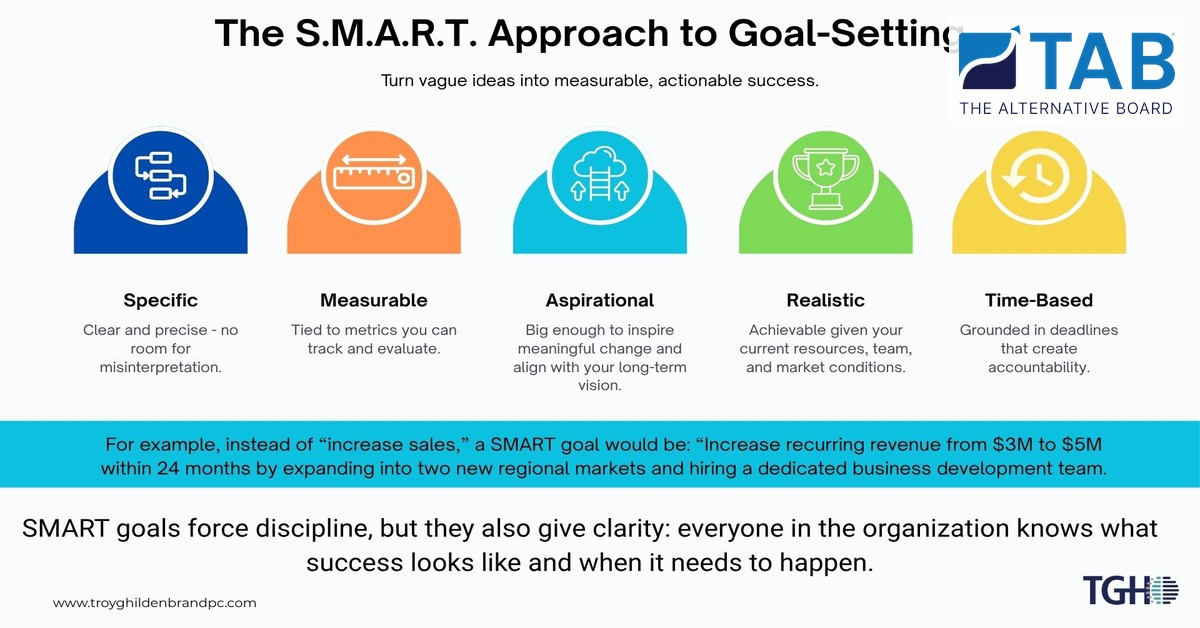
The S.M.A.R.T. Approach to Goal-Setting. Turn vague ideas into measurable, actionable success. Icons for Specific, Measurable, Aspirational, Realistic, and Time-Based.
The S.M.A.R.T. Approach to Goal-Setting Turn vague ideas into measurable, actionable success.
- Specific Clear and precise - no room for misinterpretation.
- Measurable Tied to metrics you can track and evaluate.
- Aspirational Big enough to inspire meaningful change and align with your long-term vision.
- Realistic Achievable given your current resources, team, and market conditions.
- Time-Based Grounded in deadlines that create accountability.
For example, instead of "increase sales," a SMART goal would be: "Increase recurring revenue from $3M to $5M within 24 months by expanding into two new regional markets and hiring a dedicated business development team.
SMART goals force discipline, but they also give clarity: everyone in the organization knows what success looks like and when it needs to happen.
www.troyghildenbrandpc.com TGH
From "The Owner's Almanac" - 90 days to build a business that runs without you. Available on Amazon.