
Bhushan Ekbote · April 15, 2026
The Bottleneck Audit
I was on a call last week with an owner who kept saying, "I just need to hire more people."
His revenue had flatlined. His team was busy. He was exhausted. And his instinct was to add bodies to the problem.
I asked him one question: "Where does work go to slow down in your business?"
He paused for a long time.
Then he said, "Me. It slows down with me."
That's the bottleneck audit. Not a complicated spreadsheet. Not a consultant's framework. Just an honest look at where decisions stall, where approvals pile up, and where your team stops moving because they're waiting on you.
Most owners never do this. They assume the problem is capacity. They hire. They add tools. They build processes around themselves without ever questioning why everything still runs through them.
The real issue isn't that your business is too small. It's that your business is too dependent on one person, and that person is usually you.
Before you hire your next person, before you buy the next software, before you blame the market, sit down and trace one project from start to finish. Note every point where it touched you. Note every decision that couldn't move without your input.
That map is your audit. And it will tell you more about what's holding your business back than any revenue report will.
Here's the challenge: Can you name, right now, the single biggest bottleneck in your business? And is it a process problem, or is it a you problem?
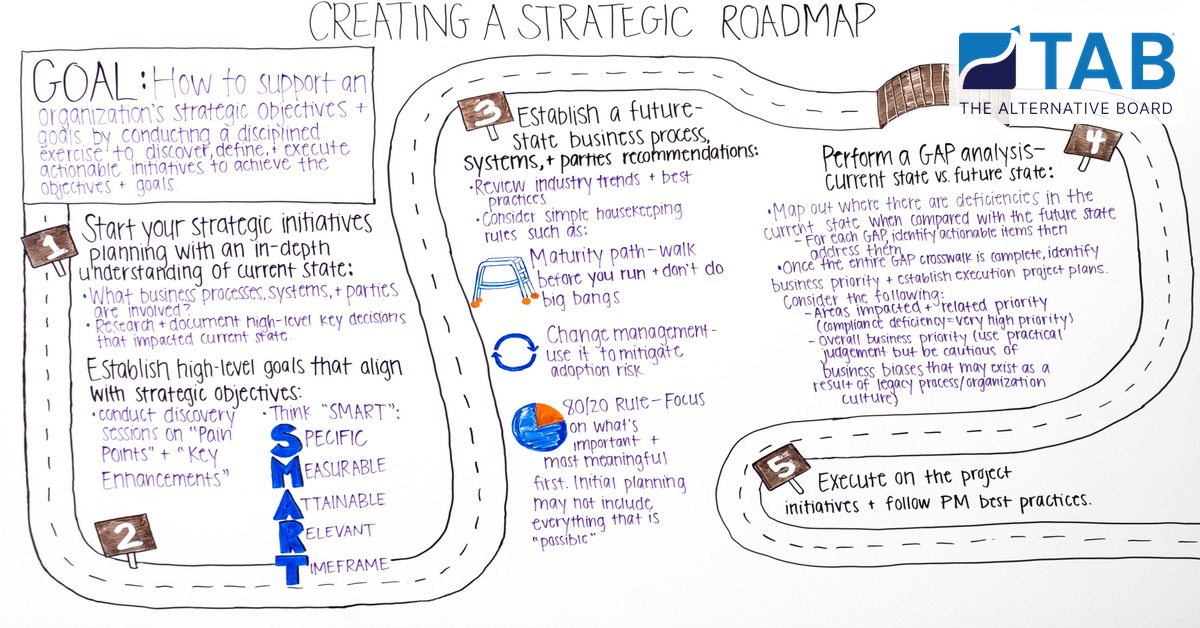
CREATING A STRATEGIC ROADMAP diagram
CREATING A STRATEGIC ROADMAP
GOAL: How to support an organization's strategic objectives + goals by conducting a disciplined exercise to discover, define, execute actionable initiatives to achieve the objectives + goals
- Start your strategic initiatives planning with an in-depth understanding of current state:
- What business processes, systems, + parties are involved?
- Research + document high-level key decisions that impacted current state.
-
Establish high-level goals that align with strategic objectives:
- Conduct discovery sessions on "Pain Points" + "Key Enhancements"
- Think "SMART":
- SPECIFIC
- MEASURABLE
- ATTAINABLE
- RELEVANT
- TIMEFRAME
-
Establish a future-state business process, systems, + parties recommendations:
- Review industry trends + best practices
- Consider simple housekeeping rules such as:
- Maturity path - walk before you run + don't do big bangs
- Change management - use it to mitigate adoption risk
- 80/20 Rule - Focus on what's important + most meaningful first. Initial planning may not include everything that is "possible"
-
Perform a GAP analysis - current state vs. future state:
- Map out where there are deficiencies in the current state, when compared with the future state.
- For each GAP, identify actionable items then address them.
- Once the entire GAP crosswalk is complete, identify business priority + establish execution project plans.
- Consider the following:
- Areas impacted + related priority (compliance deficiency = very high priority)
- Overall business priority (use 'practical' judgement but be cautious of business biases that may exist as a result of legacy process/organization culture)
-
Execute on the project initiatives + follow PM best practices.
From "The Owner's Almanac" - 90 days to build a business that runs without you. Available on Amazon.