
Bhushan Ekbote · May 28, 2026
The Cost of a Bad Hire
I had a call last week with an owner who was frustrated. He had just let someone go after eight months. Eight months of missed targets, team tension, and his own time spent managing around the problem instead of through it.
He said, "I knew by month two it wasn't working. But I kept hoping it would turn around."
That sentence tells you everything.
The cost of a bad hire is never just the salary. It's the deals that didn't close. The good employees who quietly started updating their resumes. The owner who stopped delegating because trust got broken. The months of energy spent on performance conversations that went nowhere.
Most owners calculate the cost of a bad hire in compensation. The real cost lives in what didn't happen because of that person being in the seat.
And here's what makes it worse. The longer you wait to act, the more expensive it gets. Not just financially. Culturally. The team watches how you handle it. They're taking notes on whether you protect standards or protect comfort.
The hire itself is rarely the whole problem. The problem is usually in the process that led to the hire, and in the delay between knowing and doing something about it.
If you have someone in a seat right now and you already know something is off, the question isn't whether to act. The question is why you haven't yet.
What's the story you're telling yourself that's making it easier to wait?
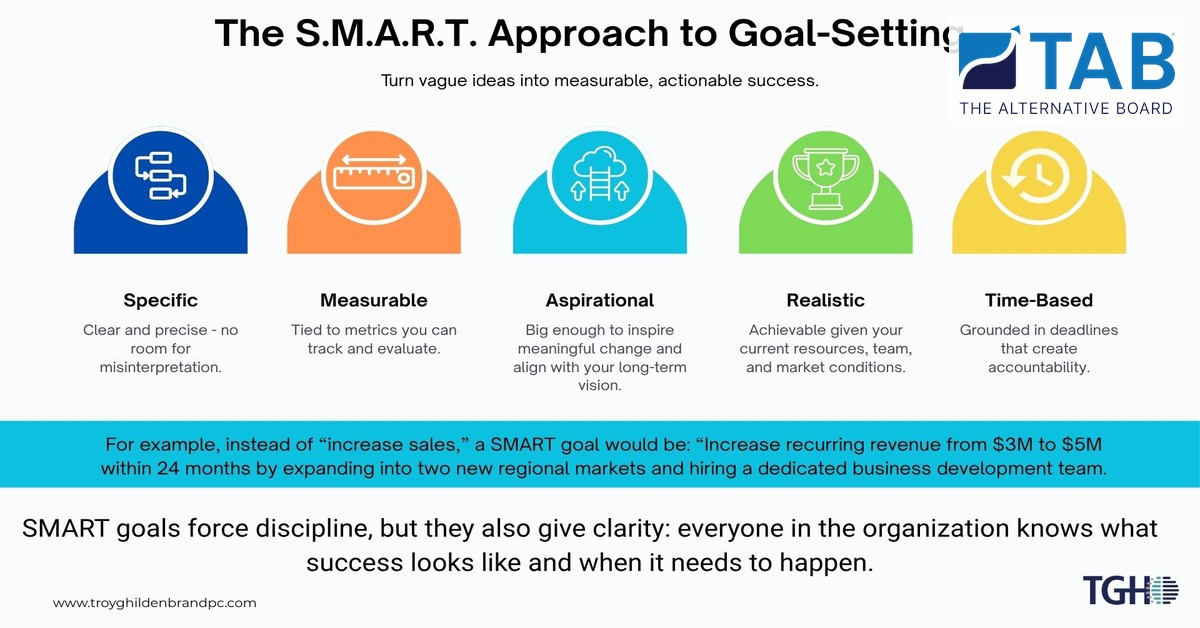
The S.M.A.R.T. Approach to Goal-Setting
Turn vague ideas into measurable, actionable success.
The S.M.A.R.T. Approach to Goal-Setting infographic showing five icons representing Specific, Measurable, Aspirational, Realistic, and Time-Based goals.
| Specific | Measurable | Aspirational | Realistic | Time-Based |
|---|---|---|---|---|
| Clear and precise - no room for misinterpretation. | Tied to metrics you can track and evaluate. | Big enough to inspire meaningful change and align with your long-term vision. | Achievable given your current resources, team, and market conditions. | Grounded in deadlines that create accountability. |
For example, instead of "increase sales," a SMART goal would be: "Increase recurring revenue from $3M to $5M within 24 months by expanding into two new regional markets and hiring a dedicated business development team.
SMART goals force discipline, but they also give clarity: everyone in the organization knows what success looks like and when it needs to happen.
From "The Owner's Almanac" - 90 days to build a business that runs without you. Available on Amazon.