
Bhushan Ekbote · May 8, 2026
Unit Economics
I had a call last week with an owner who was proud of hitting $4M in revenue. And he should be. That's real work.
But when I asked him what it cost him to acquire a customer, and what that customer was worth over time, he went quiet.
He knew his top line. He didn't know his unit economics.
Here's the thing. Revenue is a vanity number if you don't understand what's happening underneath it.
Unit economics is where the real story lives. It tells you whether you're building a business or just building a treadmill that requires more and more effort to stay in the same place.
When you know your customer acquisition cost, your average order value, your churn rate, and your lifetime value, you stop making decisions based on gut feel and start making them based on signal. You know which customers to pursue and which ones are quietly costing you money. You know whether that new marketing channel is actually working or just generating noise.
Most owners I work with have never sat down and mapped this out clearly. Not because they're not smart. Because they're too busy running the business to understand the business.
The owners who scale without chaos are the ones who treat their unit economics like a dashboard, not a report they pull once a year.
So here's the challenge. Can you tell me, right now, what a single customer is actually worth to your business over time, and what it costs you to get one?
If you can't answer that cleanly, that's where the work starts.
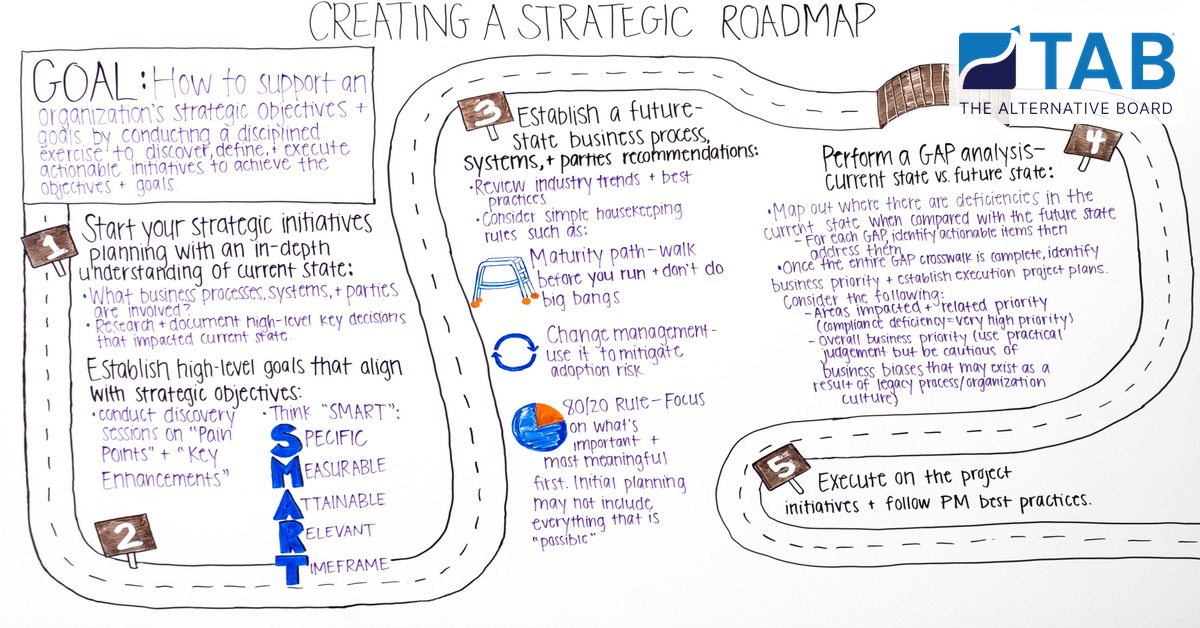
CREATING A STRATEGIC ROADMAP
GOAL: How to support an organization's strategic objectives + goals by conducting a disciplined exercise to discover, define, + execute actionable initiatives to achieve the objectives + goals
- Start your strategic initiatives planning with an in-depth understanding of current state:
- What business processes, systems, + parties are involved?
- Research + document high-level key decisions that impacted current state
-
Establish high-level goals that align with strategic objectives:
- conduct discovery sessions on "Pain Points" + "Key Enhancements"
- Think "SMART":
- S PECIFIC
- M EASURABLE
- A TTAINABLE
- R ELEVANT
- T IMEFRAME
-
Establish a future-state business process, systems, + parties recommendations:
- Review industry trends + best practices
- Consider simple housekeeping rules such as:
- Maturity path - walk before you run + don't do big bangs
- Change management - use it to mitigate adoption risk
- 80/20 Rule - Focus on what's important + most meaningful first. Initial planning may not include everything that is "possible"
-
Perform a GAP analysis - Current state vs. future state:
- Map out where there are deficiencies in the current state when compared with the future state
- For each GAP, identify actionable items then address them
- Once the entire GAP crosswalk is complete, identify business priority + establish execution project plans.
- Consider the following:
- Areas impacted + related priority (Compliance deficiency - very high priority)
- Overall business priority (use practical judgement but be cautious of business biases that may exist as a result of legacy process/organization culture)
-
Execute on the project initiatives + follow PM best practices.
From "The Owner's Almanac" - 90 days to build a business that runs without you. Available on Amazon.